
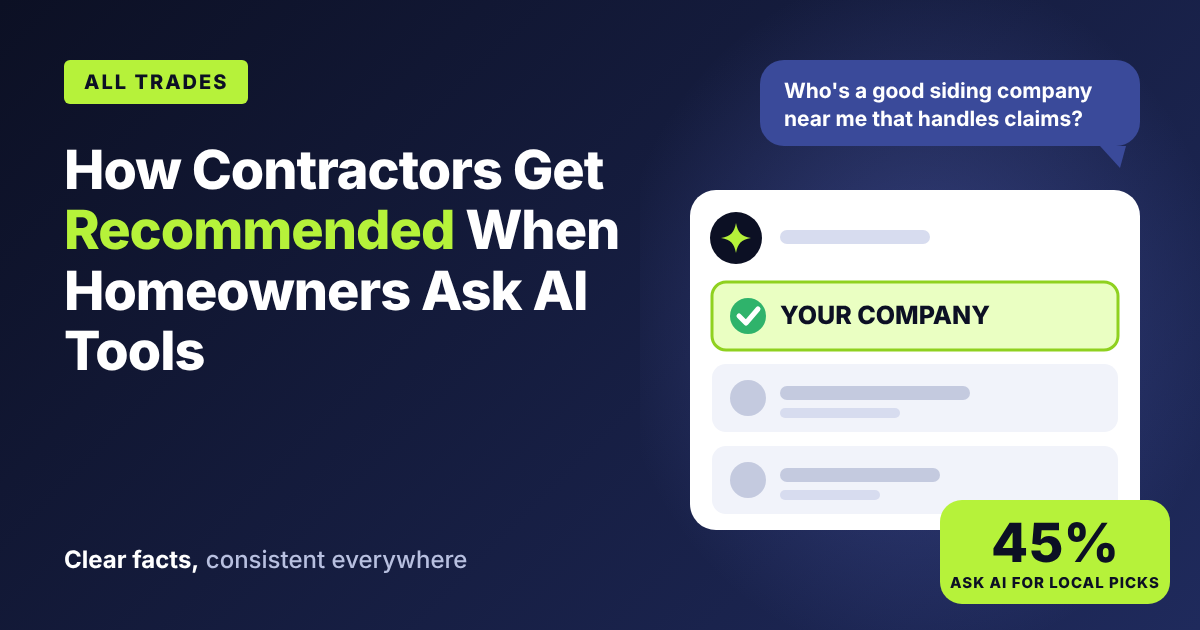
All Trades: How Do Contractors Get Recommended When Homeowners Ask AI Tools?
Short answer: Make the facts about your business clear, consistent, and easy to find in many places.
AI tools like ChatGPT build their answers from what’s already written online: your website, your Google profile, your reviews, and what other sites say about you.
The contractor described most clearly, in the most places, has the best chance of being named.
Homeowners Are Already Asking
BrightLocal’s 2026 Local Consumer Review Survey found:
- 45% of consumers used ChatGPT or another AI tool to get local business recommendations. A year earlier, that figure was 6%.
- 40% trust AI platforms for business recommendations, while 32% do not.
- 82% read AI-written summaries of reviews.
Source: BrightLocal — Local Consumer Review Survey
That’s a fast change. A homeowner who once typed “siding contractor near me” may now ask, “Who’s a good siding company in Boise that handles insurance claims?” and get three names back in a sentence.
Invisible to the New Question
Imagine a siding and window contractor named Greta. Eighteen years in business, 140 Google reviews, a solid reputation.
Out of curiosity, she asked ChatGPT for the best siding contractors in her city. Her company wasn’t named. Two competitors were, including one half her size.
She looked closer. Her website said “Exterior Solutions” across the top, with no city named on the home page. Her services page listed “cladding systems.”
Her Google profile, her Yelp page, and an old directory listing showed three different phone numbers. Her best reviews said “great job” and little else.
To a person, Greta’s company was obviously good. To a machine reading the web, it was hard to describe.
Six Ways to Be Easier to Recommend
1. Say Plainly Who You Are, What You Do, and Where
The first lines of your home page should read like a sentence a person would say:
“Greta’s Siding & Windows replaces siding and windows for homeowners in Boise, Meridian, and Nampa.”
Clear statements are easy for AI tools to repeat.
2. Keep Your Facts the Same Everywhere
Business name, address, phone number, hours, and services should match on your website, Google profile, Yelp, the Better Business Bureau, Houzz, and any directory you’re listed in.
Conflicting facts make a business harder to trust, for people and machines alike.
3. Answer Real Questions on Your Website
Build a page of the questions homeowners ask you every week, with honest answers:
- How long does siding replacement take?
- Do you work with insurance after hail damage?
- What does a window replacement cost in Boise?
AI tools often pull answers from pages written in exactly that question-and-answer shape.
4. Ask for Reviews That Say Something Specific
A review that says:
“Replaced all the siding on our 1970s ranch in Meridian after hail damage, handled the insurance paperwork.”
…carries real information.
Ask customers to mention the job, the town, and what stood out.
5. Get Mentioned on Other Sites
Look for opportunities to appear on:
- Local news websites
- Trade association member pages
- Supplier featured-contractor lists
- Chamber of commerce listings
Each one is another place where your name sits next to your trade and your town.
6. Keep It Current
Post new project photos and an update on your Google profile every few weeks.
Add a new question to your website each month. Fresh information signals an active business.
What Changed for Greta
Here’s the reality check. Nobody can promise an AI tool will name your business. These systems change often, and they don’t explain their choices.
Anyone selling a guarantee is selling something they can’t control.
What Greta could control was her own information.
Over six months, she:
- Fixed her phone numbers
- Rewrote her home page
- Added a page of 20 common questions
- Asked every customer for a specific review
She also started asking every new caller, “How did you hear about us?”
In the first months, nobody said “ChatGPT.” By month six, about three callers a month did. She won about two of every three.
At her average job of $11,000, that’s about $22,000 a month in work from a source that sent her nothing before.
Those callers also arrived better informed. The AI answer had already told them what she does and where. Most had read her questions page before they dialed.
Small, and growing. The same changes also helped her Google rankings and made her website clearer for the people reading it.
Nothing she did for AI was wasted on humans.
Your AI-Ready Checklist
- ☐ A home page that says who you are, what you do, and which towns you serve
- ☐ Identical name, address, phone, and hours on every listing
- ☐ Services described in homeowner words, not trade jargon
- ☐ A questions-and-answers page with 15 to 20 real customer questions
- ☐ Review requests that ask for the job, the town, and what stood out
- ☐ Three or more mentions on other local sites
- ☐ New photos and a profile update every few weeks
- ☐ “How did you hear about us?” asked on every call, with answers tracked
Test It Yourself
Once a month, ask two or three AI tools for a recommendation in your trade and town, the way a homeowner would.
Write down who gets named. Watch how the answers change as you fix your information.
It’s free, it takes ten minutes, and it shows you what homeowners are seeing.
When you ask an AI tool for a recommendation, do you trust the names it gives you, or check them somewhere else first?
Thomas E. Lodato, J.D. — Scale Hawk Media Group