
Remodeling: How Do Remodelers Attract Higher-Budget Clients?
Short answer: Show the kind of work you aim to do, say plainly what it costs, and make your process visible. Clients with large budgets aren’t hunting for the lowest bid. They’re buying certainty: that the job will finish on time, on budget, and without a mess in their lives. Your website, your first meeting, and your paperwork all have to prove that before they sign.
The Size of the Prize
The 2025 U.S. Houzz & Home Study surveyed nearly 22,000 homeowners about their 2024 projects. The median renovation spend was $20,000. Homeowners at the top 10% spent $140,000 or more. And 90% of homeowners worked with a professional.
Source: Contractor Magazine – Houzz Home Renovation Activity Remains Strong Amid Softening Spend
So the large projects are out there. They go to the firms those homeowners trust with that much money.
Stuck at the Median
Imagine a remodeler named Claire. Good crew, good reviews, ten years in business. Her average job is about $35,000: a bathroom here, a kitchen refresh there.
Her goal is whole-floor remodels and additions in the $100,000 to $250,000 range. Those calls rarely come. When they do, the homeowner talks with her once and hires someone else.
Claire’s website showed 60 small photos in a grid. No project stories. No prices. A contact form that asked for “project type” and “budget” with a dropdown that started at “Under $10,000.”
To a family planning a $180,000 addition, that site said: “This company does small jobs.”
Five Changes That Shift Who Calls
1. Show Whole Projects, Not Loose Photos
Claire picked her three best large jobs. For each, she wrote a one-page story covering:
- What the family hoped for
- What stood in the way
- How her team solved it
- The project timeline
- The budget range
She paid a photographer $600 a project for before-and-after shots.
2. Put a Starting Price on the Page
Her new site says:
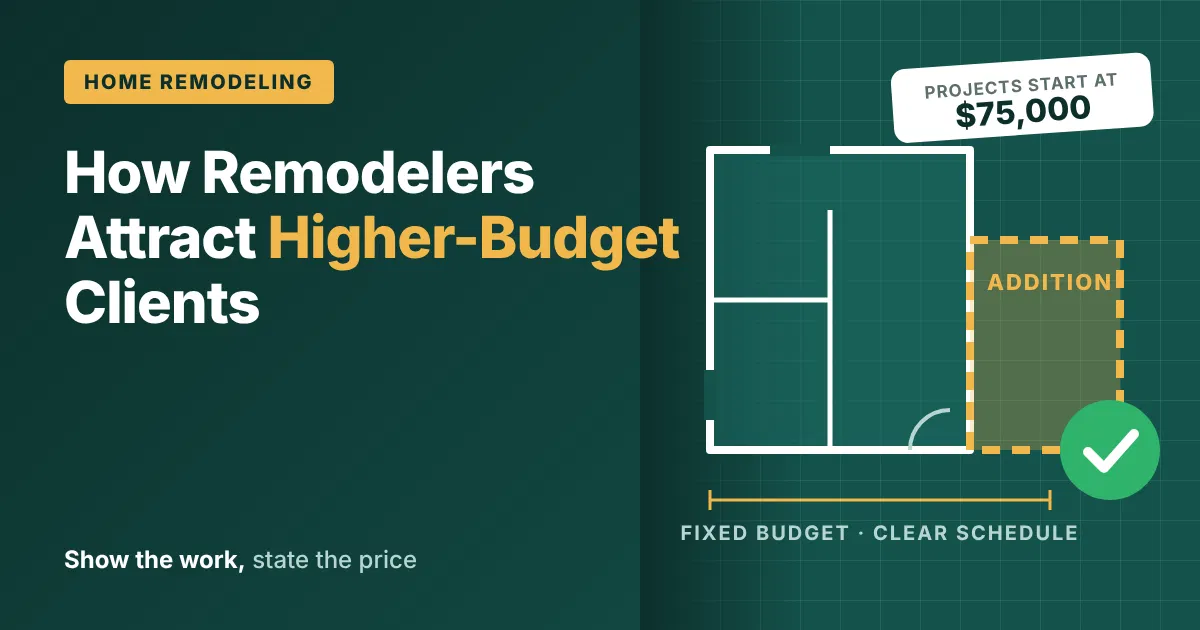
“Our whole-home and addition projects typically start at $75,000.”
That one line turned away many small inquiries. It also told the right clients they had found the right firm.
3. Charge for Design
Large clients expect a real planning phase. Claire now sells a paid design and budget agreement for $2,500, credited to the build contract if they go ahead.
Clients who pay for planning are serious. Tire-kickers fall away on their own.
4. Make the Process Visible
A page called “How a project works with us” walks through each step:
- First meeting
- Design
- Fixed budget
- Schedule
- Weekly updates
- Final walk-through
A client with $150,000 at stake reads every word.
5. Partner with Designers and Architects
Interior designers and architects meet large-budget clients months before any contractor does.
Claire took three of them to lunch, showed them her project stories, and asked how they like to work with a builder. Two now send her work.
What Changed for Claire
Here’s the reality check. Her lead count dropped at first. Calls went from about 30 a month to about 12.
The quarter after the change was hard. Small jobs that had kept cash flowing slowed down. The large jobs took three to six months to go from first call to signed contract.
By month nine, her average signed project had risen from $35,000 to about $96,000. She ran fewer jobs, with more profit in each.
She also hired a project manager, because a $150,000 job with weekly client updates can’t run on the owner’s evenings.
The First Meeting Sets the Tone
The website gets the call. The first meeting wins or loses the job. Claire changed hers, too.
She arrives with a folder containing:
- A sample contract
- A sample schedule
- A sample weekly update
- A one-page list of the questions she’ll ask
She asks about how the family lives in the house before she asks about cabinets. She takes notes by hand. She leaves on time.
Before she drives away, she tells them exactly what happens next and when they’ll hear from her. Then she follows through on that date.
A client weighing three firms remembers the one who did what she said, on the first try.
What Large-Budget Clients Look For
They rarely say it out loud, so here it is plainly:
- A firm that has done this size of job before, with proof
- A clear budget and what could change it
- A schedule they can plan their lives around
- One person who answers their calls
- A clean, safe job site, especially if they’re living there
- Paperwork that looks professional: a real contract, a real schedule, real change orders
None of these require a bigger truck or a fancier logo. They require a business that looks organized from the first click.
Your Higher-Budget Checklist
- ☐ Three project stories with photos, timeline, and budget range
- ☐ A starting price for your target project size on the website
- ☐ A contact form that starts at your target budget
- ☐ A paid design agreement, credited to the build contract
- ☐ A “How a project works” page
- ☐ Two to three designers or architects who know your work
- ☐ A project manager, or a plan to hire one
- ☐ A sample contract and schedule you can show at the first meeting
Start with Your Best Three
Pick your three best jobs, even if they’re older. Write their stories this month. Those three pages will do more for your next large client than a hundred more photos in a grid.
When you’re spending six figures on your home, what makes you trust one remodeler over another?
Thomas E. Lodato, J.D. — Scale Hawk Media Group