
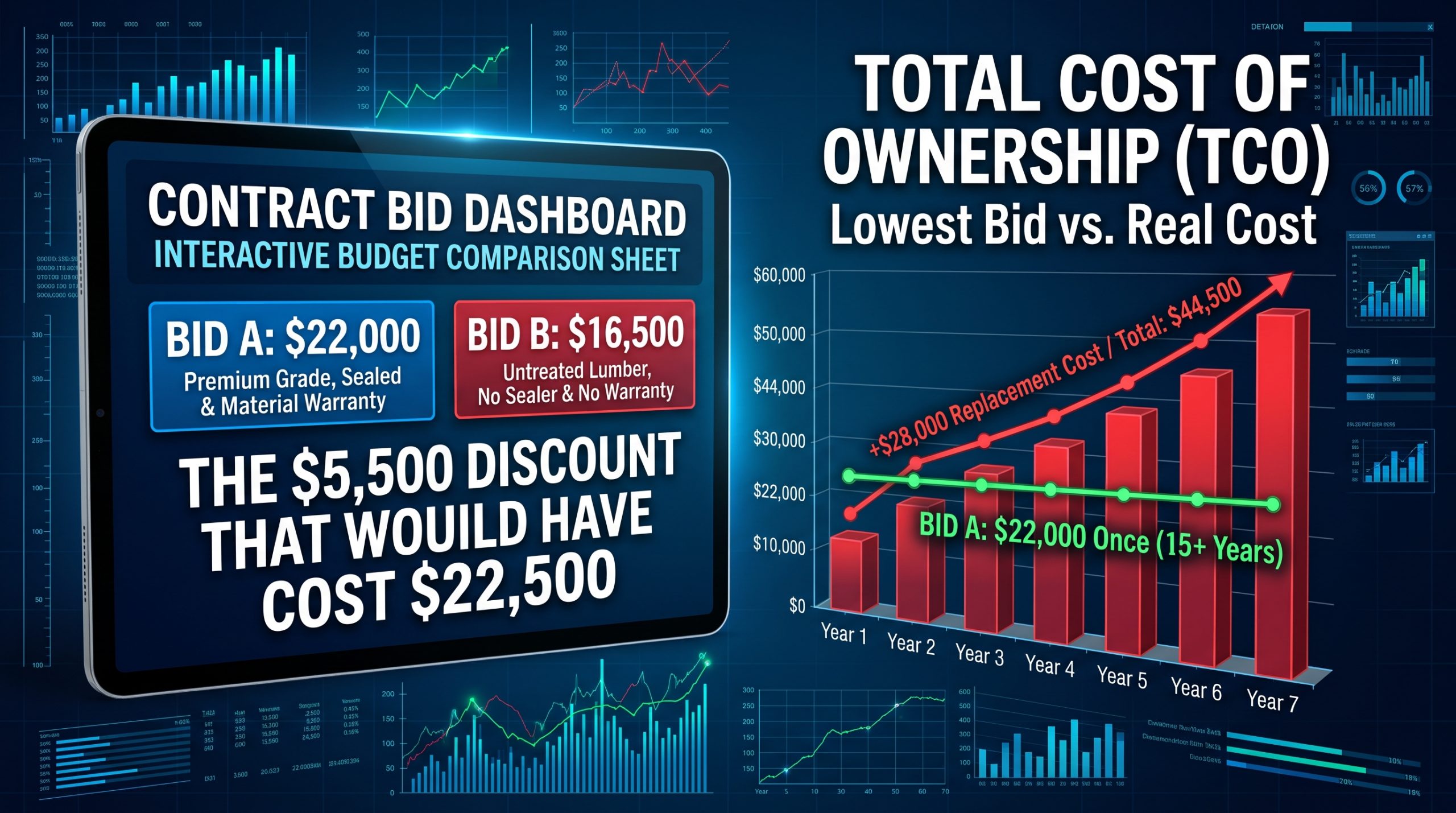
The $5,500 Deck Discount That Would Have Cost $22,500
How one missing line on a bid can cost you four times the savings.
SEO Title: Lowest Contractor Bid vs. Total Cost of Ownership
SEO Description: Two deck bids, $5,500 apart. One missing line would have cost the homeowner $22,500. How to read a bid before you sign.
Cover Image: Close-up of a split, weathered deck board next to a solid, sealed one.
Would you take a $5,500 discount on the same deck?
Most people say yes. A homeowner I helped almost did.
She had two bids for the same deck:
- Contractor A: $22,000
- Contractor B: $16,500
“It’s the same deck for $5,500 less,” she said.
I asked her one question. By the end of this story, you’ll see why that question was worth $22,500 to her.
One question
“Did both contractors name the lumber grade?”
We looked at the bids together.
Contractor A named premium pressure-treated lumber. He listed a marine-grade sealer. He gave a 10-year material warranty.
Contractor B wrote two words: “pressure-treated lumber.”
No grade. No sealer. No warranty.
On a quick read, those bids look the same. They are not the same deck.
What “pressure-treated” can hide
“Pressure-treated” covers a wide range of wood. Some is made to touch the ground. Some is only rated for use above it. Some boards are clean and dry. Others are full of knots and splits.
When a bid names no product, the builder can buy the cheapest wood that week. And you can’t object. Nothing was promised.
How $5,500 turns into $22,500
Here is how decks built with cheap, unsealed wood tend to age:
- Year 1: It looks great.
- Year 3: Boards warp and split. Screws back out.
- Year 5: Soft spots. Loose rails. A safety worry.
- Year 7: Tear it out and start over. Cost: about $28,000.
Contractor A’s deck? Still solid at year 15.
Now add it up:
| Contractor | Cost |
|---|---|
| Contractor B | $16,500 up front + $28,000 to replace = $44,500 by year 7 |
| Contractor A | $22,000, once |
The “expensive” deck would save her $22,500. That’s before the mess, the lost summers, and the risk of a rail giving way under a guest.
A reality check: not every cheap deck fails in seven years. Some last longer. The risk is real, though. And when it hits, it costs far more than the discount saved.
Price is not cost
Over 40 years in construction taught me this:
The lowest price rarely gives you the lowest total cost.
Price is what you pay on day one. Cost is what you pay over the life of the thing. Repairs, replacement, stress, and risk all count.
When one bid comes in far below the rest, the builder is not being generous. Something got cut. You just can’t see it yet. Most often it’s one of these:
- Materials: Lower grades, thinner boards, no rating.
- Prep work: Footings, flashing, and fasteners. You never see them once the deck is built.
- Protection: The sealer, and the time to put it on right.
- A promise: No warranty means no one stands behind the work.
How to compare two bids
You can read a bid like a pro in six steps:
- Line the bids up side by side. Anything one names and the other skips is a question.
- Ask for product names. Lumber grade, decking brand, screws, sealer. Treated wood eats plain steel, so ask what the screws and hangers are rated for.
- Ask what’s underneath. How deep are the footings? How does the deck attach to the house? Is that joint flashed? This is where decks fail.
- Get the warranty in writing. Ask for both the materials warranty and the workmanship warranty, and how long each lasts.
- Confirm the permit. Who pulls it? Is it in the price?
- Ask the low bidder straight out. “You’re $5,500 lower. Where is the difference?” A good builder answers plainly. A vague answer tells you plenty.
Contractors: show what you’re selling
If you keep losing to the cheaper bid, this part is for you.
Contractor A’s bid did the selling for him. He named the grade, the sealer, and the warranty. When the homeowner compared bids, his page showed exactly what her money bought.
If your bid just says “pressure-treated lumber” while you install premium wood, you’re hiding your best selling point. So spell it out:
- Name every product.
- Put the warranty on page one.
- Add one line on what it means: “Built to last 15+ years with basic care.”
Clients can only pay for value they can see.
What are you really buying?
Once the math is on the table, the $5,500 stops looking like a discount. It looks like a down payment on a repair bill.
Every bid you sign is a bet on the future. The smaller number today matters less than the choice you’ll be glad you made in year seven.
Can you see how one missing line changes the whole picture?
What are you really buying: a price, or a deck that lasts? Tell me about a time the cheaper option cost you more.
Follow me for a new lesson from the job site every week.