
Handyman: How Do Handyman Businesses Get More Referrals and Repeat Work?
Short answer: Treat every job as the first visit, not the only one. Leave each customer with a written list of what else you noticed, check in each season, and make it easy to book you again.
A handyman who becomes “our guy” for 200 households rarely has to buy an ad.
Keeping Customers Pays More Than Finding Them
Fred Reichheld of Bain & Company is known for one finding about loyal customers.
As CIO magazine reported in 2002, his research found that:
“A 5 percent increase in customer retention rates results in a 25 percent to 95 percent increase in profits.”
Source: CIO — How to Build Customer Loyalty
That research covered many kinds of businesses, not handymen in particular. The idea fits the trade well, though. A customer who calls you back costs nothing to find. A new one costs ads, bids, and drive time to meet a stranger.
One-and-Done
Imagine a handyman named Sam. Good with his hands, honest, always on time. He does about 300 jobs a year: a leaky faucet, a sticky door, a TV on the wall, drywall patches.
Most of those customers rarely call again. Not because they were unhappy. Because they forgot his name.
Three months later, the next small problem shows up, they search online, and they find someone else.
Sam was spending about $900 a month on ads to keep finding new customers to replace the ones who drifted away.
Five Habits That Bring Customers Back
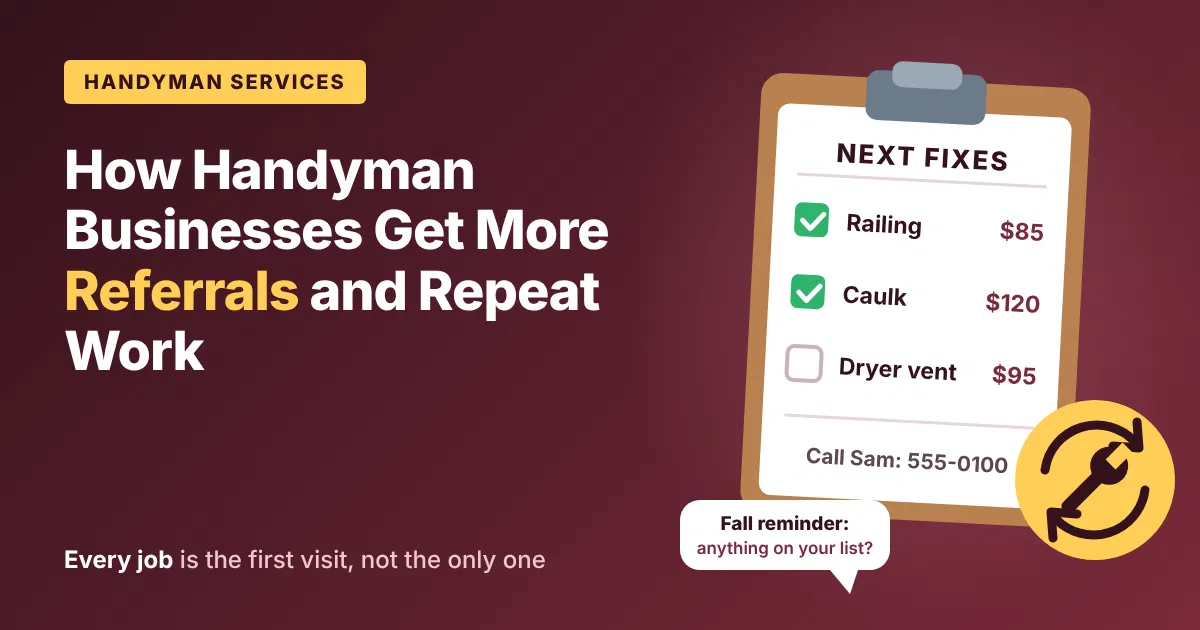
1. Leave a “Next Fixes” List
At the end of each job, Sam walks through the house with the homeowner, with their permission.
He writes down two or three things he noticed:
- A loose railing
- A cracked caulk line in the shower
- A dryer vent full of lint
He adds a rough price for each. Then he leaves the list on the counter with his name and number at the top.
He doesn’t push. He just writes it down.
Weeks later, the list is still on the fridge, and Sam is the one they call.
2. Text a Seasonal Check-In
Four times a year, Sam sends a short text to past customers:
“Hi, it’s Sam the handyman. Fall reminder: now’s a good time to clean gutters, test smoke alarms, and seal drafty doors. If anything’s on your list, reply and I’ll get you on the schedule.”
Short, useful, and easy to answer.
3. Sell a Block of Time
Many homeowners have a running list of small jobs.
Sam created a “half-day visit”: four hours for $340, booked ahead.
Customers save up their list, and Sam gets a full morning of paid work in one driveway instead of four.
4. Make Every Visit Easy to Recommend
Text when you’re on the way. Wear shoe covers. Clean up better than you found it.
Small, visible habits are what customers mention when a neighbor asks, “Do you know a good handyman?”
Many handyman customers are older homeowners or busy parents. They’re letting a stranger into the house, often while they’re alone.
Reliability is the product as much as the repair. Show up when you said, finish what you started, and tell them before you leave exactly what you did.
That’s what turns a single repair into a standing relationship.
5. Ask for the Referral, and Thank It
At the end of a visit that went well, Sam says:
“If a neighbor ever asks about a handyman, I’d be glad to help them, too.”
He leaves two cards. When a referral books, he sends a handwritten thank-you note.
Keep a Simple Customer List
None of this works if you can’t find your customers again.
Sam keeps a simple list, in a spreadsheet or a scheduling app, with:
- Customer name
- Address
- Phone number
- Date of last visit
- Work completed
- “Next fixes” he wrote down
Before each seasonal text, he sorts by last visit. Anyone he hasn’t seen in six months gets a personal note instead of the general one.
What Changed for Sam
Here’s the reality check. Some customers preferred no texts, so Sam asked first and took them off the list when asked.
Some “next fixes” lists went in the trash. And tracking it all took about an hour a week, which Sam found hard to keep up at first.
Over the next year, repeat visits rose from about 70 a year to about 340.
At his average ticket of $380, that’s about $129,200 of work from people who already knew him.
He cut his ad spending from $900 a month to $300. The calendar stayed full, and more of each day was spent working instead of driving to meet strangers.
Your Repeat-Work Checklist
- ☐ A “next fixes” list left at every job, with rough prices
- ☐ A customer list with last visit, work done, and next fixes
- ☐ A seasonal text four times a year, sent only to people who agreed
- ☐ A half-day or full-day visit customers can book ahead
- ☐ An on-the-way text before every visit
- ☐ Shoe covers and a full cleanup on every job
- ☐ Two referral cards left after every visit that went well
- ☐ A handwritten thank-you for every referral that books
Start This Week
At your next job, write down three things you noticed and leave the list behind.
It takes five minutes. It may be the most profitable five minutes of your week.
When you find a handyman you like, what makes you call them back instead of searching again?
Thomas E. Lodato, J.D. — Scale Hawk Media Group