
The $8,000 Savings That Ended Up Costing $9,000 More
The lowest bid wins the job. The best bid wins the outcome.
Have you ever picked the lower bid and watched it climb week after week?
I’ve seen this pattern dozens of times in 40 years. It usually goes like this.
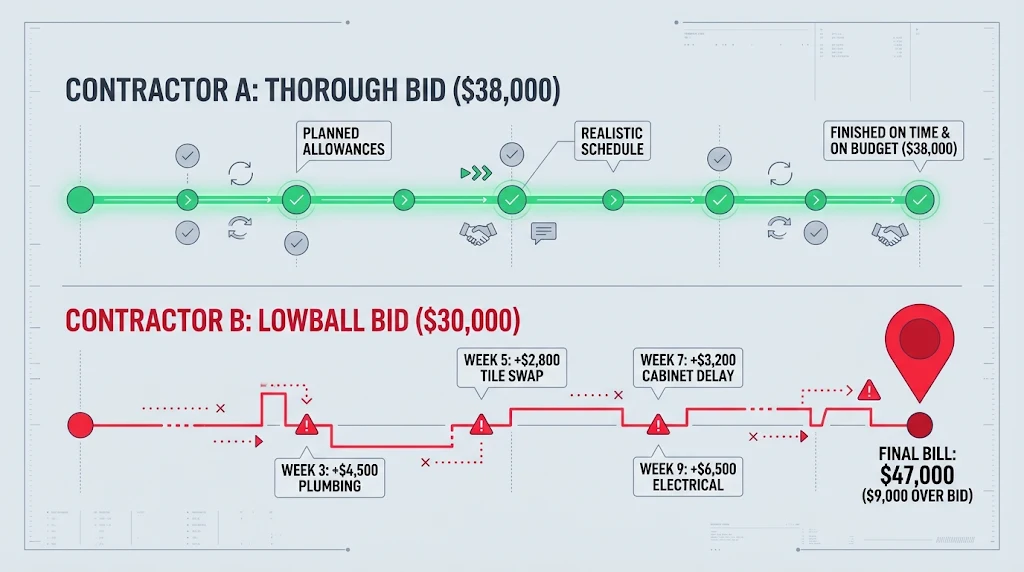
Two contractors bid the same kitchen remodel. Both are qualified. Both are experienced. Both have good portfolios.
- Contractor A: $38,000
- Contractor B: $30,000
The homeowner picks Contractor B and saves $8,000 up front.
Then the phone starts ringing.
The Change Orders
Week 3: “We found some plumbing issues. Need another $4,500.”
Week 5: “The tile you picked isn’t available. This one costs $2,800 more.”
Week 7: “Cabinets are delayed. We can rush them for $3,200.”
Week 9: “The inspector flagged the electrical. We have to rewire. $6,500.”
<text> </text>
The final bill: $47,000.
That’s $9,000 more than Contractor A’s bid. Plus three extra weeks. Plus a new surprise every other week.
Contractor A’s bid had planned for all of this. It had allowances for unknowns. It had a clause for rising material prices. It had a realistic schedule. Everything the “expensive” contractor quoted was in writing from day one.
The lowest bid wins the job. The best bid wins the outcome.
That’s what my years in construction keep teaching me.
Some low bidders aren’t confident enough to price the job right. So they bid low to win the work. Then they earn their margin back through change orders.
Great contractors price it right the first time. They plan for the unknowns. They spare you surprise bills. They finish on time and on budget.
That $8,000 “savings” was never a discount. It was bait.
To Be Fair: Some Change Orders Are Honest
Remodeling has real unknowns. Nobody can see inside a wall until it’s opened. Old pipes and wires can hide problems no honest contractor could have priced ahead of time. And when clients change their minds, those changes should cost money.
So the real test is simple: did the bid plan for change orders?
Contractor A expected surprises and priced a cushion for them. Contractor B priced as if nothing would go wrong. So every problem became the client’s bill.
Same kitchen. Same surprises. A very different experience.
How to Spot a Lowball Bid Before You Sign
If you’re comparing bids, look past the total. Check these six things:
- Allowances. Does the bid set aside money for tile, fixtures, cabinets, and unknowns? Do the amounts match what you’ve asked for? A low allowance is a future change order.
- Exclusions. What does the bid leave out? Permits, disposal, electrical upgrades, patching, and painting are common gaps.
- Contingency. Is there a plan for hidden problems? A line item, or a written process?
- Material Prices. How does the bid handle price increases or swaps?
- Schedule. Is the timeline realistic, or suspiciously fast? Ask what lead times the contractor assumed for cabinets and special orders.
- The Change-Order Process. Will you see the cost in writing and approve it before the work starts?
Then ask the low bidder straight out:
“Your bid is $8,000 lower. What’s in theirs that’s missing from yours?”
The answer, or the silence, will tell you a lot.
Contractors: Price It Right, and Say So
If you keep losing to lower bids, cutting your price may be the wrong fix. You may just have to make your thoroughness visible.
Show your allowances and contingency clearly. Explain why they’re there.
Explain the gap. Tell clients what a low bid may be missing, and give them questions to ask the other contractors.
Put your change-order policy in writing. It shows you’ve thought about the unknowns.
Track your record. “Our last ten kitchens finished within X% of the contract price” is a powerful line, when it’s true. Track it so you can say it.
A client who understands your bid is much harder to lose to a lower number.
What Are You Really Comparing?
The real question is not “Who’s cheapest?”
It’s:
“Who will deliver what they promised, for the price they promised, when they promised?”
That’s worth paying for.
Does that week-by-week list look familiar?
Have you been on either side of a change-order spiral? What would you tell someone comparing bids right now? Share it in the comments.
Follow me for a new lesson from the job site every week.
SEO Information
SEO Title: Low Contractor Bids and the Change Order Trap
SEO Description: A $30,000 kitchen bid beat a $38,000 bid, then grew to $47,000 through change orders. How to spot a lowball bid before you sign.
Suggested Cover Image: A stack of change-order forms on a clipboard in a half-finished kitchen.