
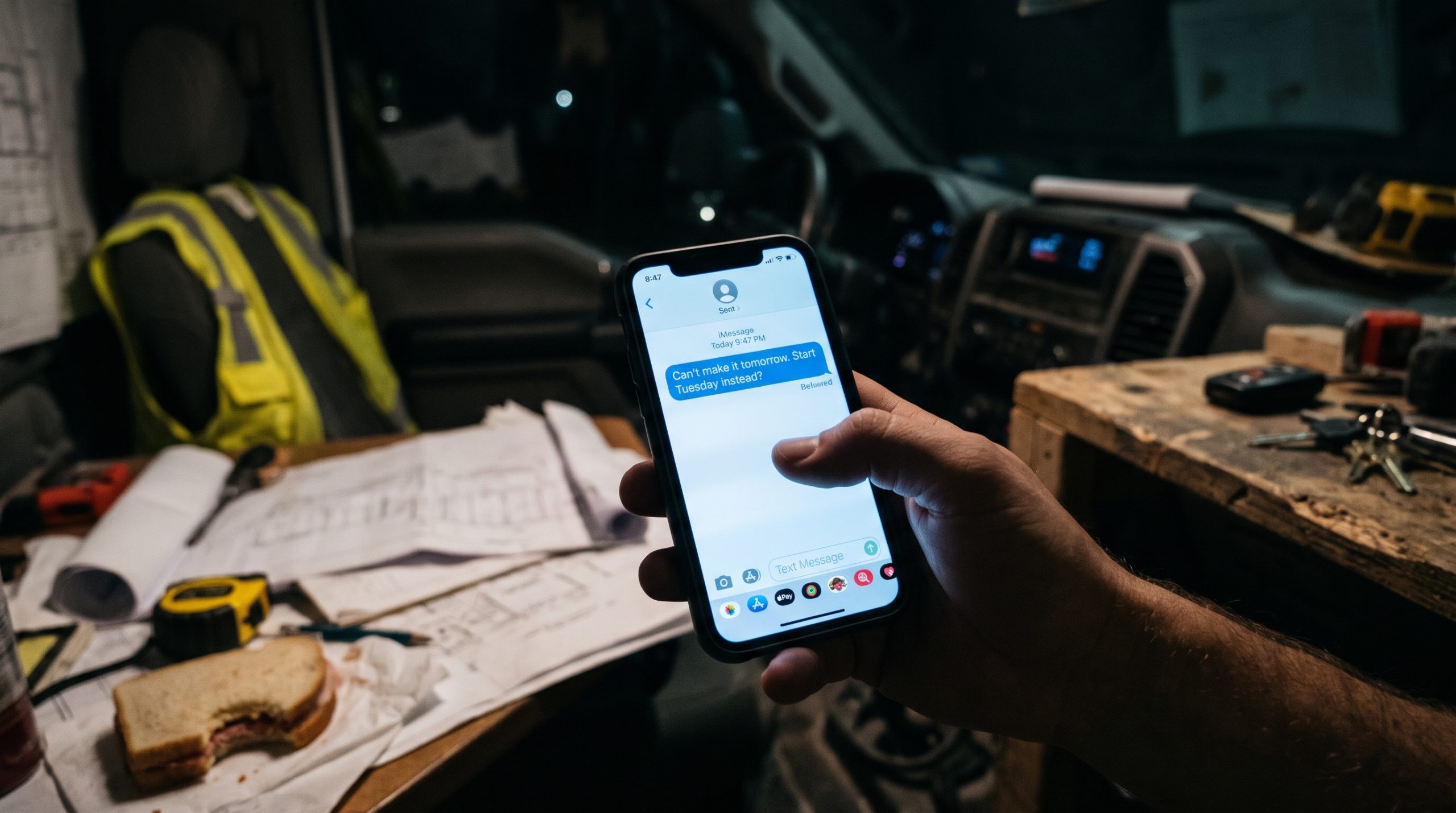
The Text Message That Cost a Contractor $86,000
Clients forgive delays. They don’t forgive feeling unworthy of a phone call.
SEO Title: How One Text Message Cost a Contractor an $86K Job
SEO Description: A fair delay, sent by text at 9:47 PM, cost a contractor an $86,000 kitchen remodel. How to deliver bad news so clients stay.
Cover Image: A phone on a nightstand at night, a short text glowing on the screen.
“Can’t make it tomorrow. Start Tuesday instead?”
That text message cost a contractor $86,000.
The delay didn’t cost him the job. Something else did.
The story
The contractor was set to start a kitchen demo on Monday morning.
The homeowners had taken the week off work. They had moved into a hotel. They had planned their lives around his schedule.
Sunday night, 9:47 PM, the text arrived:
“Can’t make it tomorrow. Start Tuesday instead?”
No reason. No apology. No phone call. Just a text.
The homeowners were furious. The delay itself didn’t bother them. Things happen. The text did. A big promise, broken by text, close to 10 PM the night before, felt like a slap.
They called three other contractors Tuesday morning. By Thursday, they had hired someone else.
The first contractor lost an $86,000 kitchen remodel over one text.
The part that makes it worse
His reason was real.
His demo crew’s truck broke down Sunday afternoon. He spent the evening hunting for another crew. When that failed, the text felt like the fastest fix.
Now imagine he had called at 6 PM instead and said:
“Hey, I need to be straight with you. My crew’s truck broke down. I’m working on getting another crew there tomorrow, but I might need to push the start to Tuesday to make sure I have the right people. I know you took time off and this messes up your plans. I’m really sorry. Can we talk through options?”
The homeowners would almost surely have said, “Thanks for calling. Tuesday works.”
Everyone knows trucks break down. No one likes a casual 10 PM text about a project they’ve planned for months.
It’s how you say it
The facts in both versions are nearly the same. The start moves one day either way. What changes is what the message says about how you see the client.
A phone call says:
- You matter.
- I respect your time.
- I own this.
A late-night text says:
- You’re a small problem on my list.
Clients remember how you made them feel long after they forget what happened. A one-day delay fades in a week. Feeling brushed off is the story they tell their friends.
These homeowners had already given a lot before demo day: vacation days, hotel nights, months of planning. To them, Monday was a big day. The text treated it like a scheduling detail.
Match the channel to the message
Texting is a great tool on a job. It’s fast. It leaves a record. Clients like quick updates. The mistake is using it for the wrong kind of news.
Here’s a simple rule:
Text good news and logistics.
- “Tile arrived.”
- “Inspector is set for 10 AM.”
- “Here’s a photo of today’s work.”
Call with bad news and changes.
Delays, price increases, problems found. Anything that touches the client’s money, time, or plans.
Follow the call in writing.
After you talk, send a short text or email confirming the plan. Now you have the relationship and the record.
A bad-news playbook for contractors
Every contractor delivers bad news sooner or later. The ones who keep clients do it the same way every time:
- Call as soon as you know. Before you’ve solved it. The 6 PM call beats the 10 PM text. The 3 PM call beats both.
- Lead with the truth. “I need to be straight with you” tells them you’re hiding nothing.
- Explain in a sentence or two. Skip the long excuses.
- Name what it costs them. “I know you took time off.” That one line does more repair than anything else you say.
- Apologize and mean it. Own it. Blame no one.
- Give them choices. A Tuesday start, a partial start, a new schedule. Hand back some control.
- Confirm in writing. A short text with the new plan.
Those seven steps take five minutes. Skipping them cost this contractor $86,000.
What clients are really buying
Homeowners who hire you are buying more than a kitchen. They’re trusting you with their home, their money, and months of disruption. Every call, text, and visit tells them whether that trust is safe.
That contractor didn’t lose the job because of a delay. He lost it because one text told his clients they weren’t worth a phone call.
Does that sound like a text you’ve received, or sent?
Contractors: what’s your rule for calling versus texting? Homeowners: has the way bad news arrived ever changed how you felt about a contractor? Share it in the comments.
Follow me for a new lesson from the job site every week.